
Expanding Reach in West Africa: FEM’s Year-End Report
TL;DR
In 2025, FEM launched a new campaign in Kaduna, Nigeria, reaching ~500,000 potential listeners, conducted audience research with 1,084 potential listeners in Niger, and completed production of Season 1 of our upcoming multi-state campaign in Nigeria. In expansion, we completed successful proofs of concept in Benin and Togo. On our RCT, we installed evaluation technology across first-wave Nigerian states, with troubleshooting focused on achieving reliable live broadcast triggering. An academic paper found no sustained increase in public-sector contraceptive service use in Kano. We treat the finding cautiously due to data and design limitations, and conflicting survey evidence. Organisationally, Anna Christina Thorsheim is transitioning to Board President, with co-directors Kenneth Scheffler and Lia Boldt continuing executive leadership. FEM is fundraising for campaigns which could reach ~17.6 million potential listeners and prevent ~170,400 unintended pregnancies.

Enumerator Prudencia Hounkpe speaks with potential listener
Tchibozo Odile Adjadohoun during a user conversation in Benin.
Strategy at a Glance
In 2025, FEM worked to deliver impact in a much more uncertain external environment. As major cuts to global health funding reshaped the contraceptive supply landscape, we adapted our upcoming Nigeria campaign to states where increased demand could be met.
Across the year, FEM concentrated on three strategic priorities: delivering family planning radio campaigns, testing and expanding into new countries, and strengthening the evidence base for our model through a large randomised controlled trial (RCT).
Delivering family planning radio campaigns
Launching in Kaduna
In 2025, FEM established that Kaduna State could not be included in our RCT because security conditions make it unsafe to install equipment or collect data. That gave us the opportunity to launch a full-scale campaign independent from the RCT. FEM launched a radio campaign in Kaduna State in November in partnership with Invicta FM.
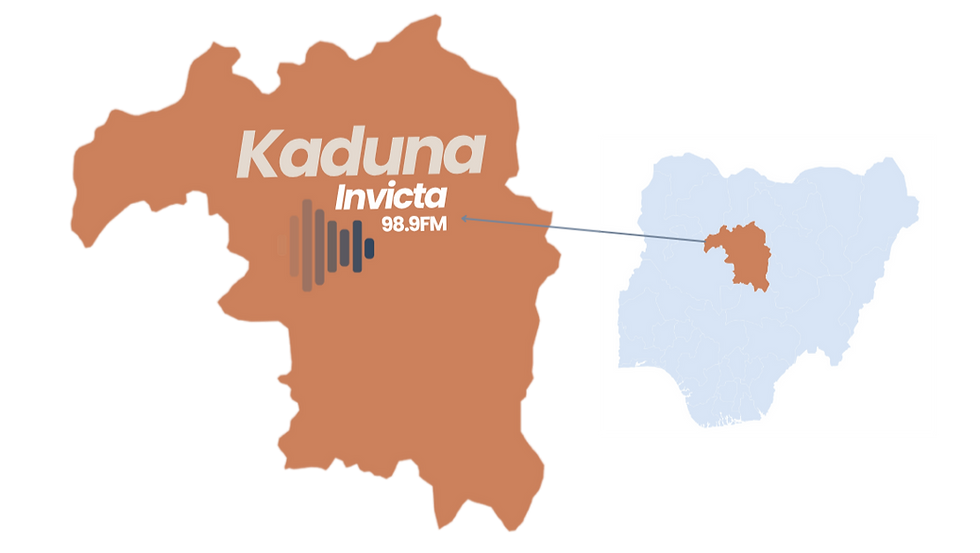
FEM’s 30-min shows hit the airwaves six times per week,
while 1-2 minute ads are broadcast 10x per day.
Kaduna sits on the northern high plains and borders Kano, where FEM has already implemented 1.5 years of successful programming. Home to more than 60 ethnic groups, Kaduna is a highly religious state where both Islam and Christianity are deeply rooted; our content for North Nigeria is specifically tailored to respond to religion-based concerns about childbirth spacing, among other barriers. FEM’s programs will air in Hausa, one of the state’s most widely spoken languages.
The campaign is modeled to reach ~500,000 potential listeners. Based on our impact model, it could generate ~39,000 Couple Years of Protection (the equivalent of one couple being protected from unintended pregnancy for one year), avert ~11,400 unintended pregnancies, save ~57 maternal lives, and prevent ~2,300 disability-adjusted life years (DALYs).
This campaign represents the work for which FEM was founded: bringing high-quality, evidence-based communication to places where it can make a difference in reproductive health and well-being.
Preparing for a Two-Year Campaign in Niger
We previously conducted a successful proof of concept (POC) in Niger. This year, we conducted formative research with 1,084 potential listeners, in advance of a two-year campaign in the regions of Zinder, Maradi, and Tahoua. Research revealed that how people navigate family planning in Niger closely mirrors northern Nigeria.
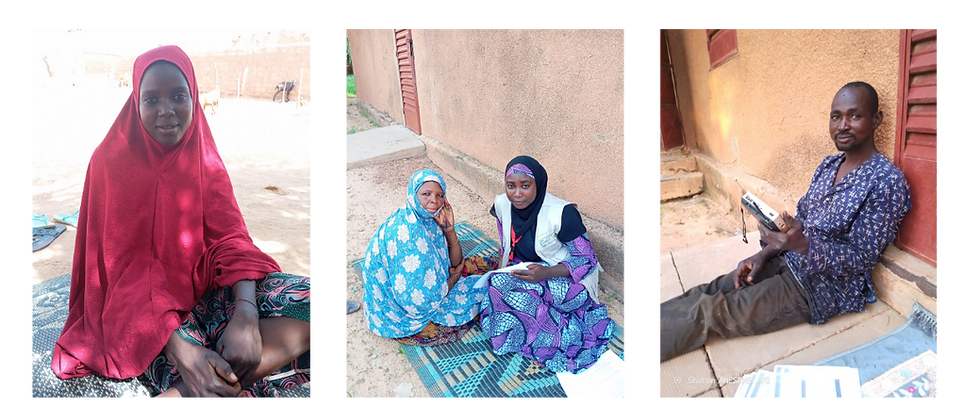
Faces from Niger: potential listeners and an enumerator
pose during user conversations
We tested scripts originally developed for northern Nigeria in a blind review with stakeholders. Participants warmly received both Nigerian and Nigerien-developed scripts, suggesting strong cross-context relevance. We field-tested 14 shows and 10 ads for the first season of this cost-effective campaign. One listener described the programme as “a real eye-opener.”
Producing Season 1 of Nigeria RCT
We completed content production for Season 1 of our RCT campaign, and began work on Season 2. This campaign, in three regions and languages, is our largest and most complex content production to date. It will be aired in 10-12 states in North, South East, and South West Nigeria, reaching ~17.9 million potential listeners.
To ensure our content connects with those we serve, we tested our shows and ads with potential listeners. Pre-testing included 42 individual interviews and six focus group discussions, divided between men and women, in both rural and urban areas. Feedback from these sessions helps us understand how well the content resonated with audiences, what they retained, and how much they enjoyed it.
During a focus group discussion about a FEM programme in Abia, a 23-year-old mother of one shared her reaction: “Their voices were wonderful, very powerful… It’s important for women to understand how to plan their lives and their families, to know how many children they can manage and care for properly. That way, each parent will have the strength to raise their own children well, without having to depend on others to take care of them.”
Local writers created our fiction scripts, supported by FEM’s Creative Lead Idi Nasiru. Nasiru is a social and behavioural change communications specialist with experience at BBC Media Action and Johns Hopkins’ Center for Communication Programs. He played a key role in narrative quality and cultural resonance, particularly for northern Nigeria.

Idi Nasiru speaks with FEM Strategy Director Lia Boldt
at FEM’s team retreat in Abuja
“This campaign is saving my family, my neighbors, people I know,” Idi shared. “I lead the team creating it, and we’re all from these communities. We’re not writing for an audience, we’re speaking to our own people. That’s what makes it personal, what makes it a lifesaver.”
Testing and Expanding into New Countries
We reached an exciting milestone in international expansion: our first radio broadcasts in Benin and Togo.
Benin: First Broadcasts and Early Signals
With our local partner, ONG Eclosion, we completed a successful POC to assess feasibility for campaigns in the regions of Littoral, Atlantique, Ouémé, and Zou, where we could reach ~1.3 million listeners.
We began by introducing FEM’s work at a stakeholder workshop in Porto-Novo, attended by 40+ participants, including youth mayors, local kings, and community dignitaries. Our work received strong support.
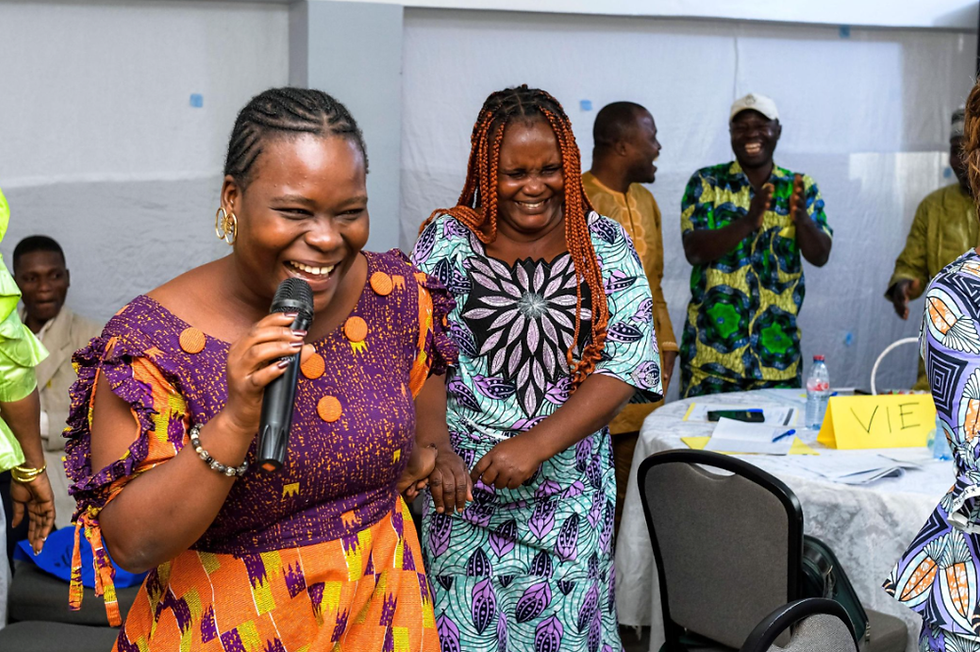
Journalist Obame Sara (left) and community leader and teacher Hotegni Laurence
share a moment of laughter at FEM’s stakeholder workshop in Porto-Novo.
We conducted user conversations to understand how potential audience members think about family planning. Insights from these conversations guided the development of two short radio ads, written and produced by local creatives. The Fon-language ads were pre-tested with listeners before airing for one week on two stations in southern Benin.
Following the campaign, we conducted a listener survey. Recall was high across both ads, and many listeners reported discussing the messages with their spouse. These early signals suggest the content was understandable, memorable, and relevant enough to prompt conversation. For Ad 1, 29 of 37 listeners remembered having heard the ad, and 28 remembered the core messages of the ad: "You can ask your health center for advice on which method of contraception is right for you," and "Spacing births protects mothers’ health." For Ad 2, 35 of 37 listeners remembered having heard the ad, and 28 remembered the core messages of the ad.
After the successful POC, we tested a different sequence by airing a nine-week campaign focused on the most clear barriers identified in early user conversations, before conducting our full formative audience survey. This approach allows us to assess which barriers remain most important after some initial airing, and reduces the risk of focusing too long on barriers that may be addressed early in a campaign. We expect this to generate useful learning for future campaigns.
Togo: a Successful Proof of Concept
In Togo, we completed a successful POC with our local co-implementing partner ISCOME. In this country, we can reach ~2.3 million potential listeners in the regions of Maritime, Plateaux, Savenes, and Kara. Local partners and stakeholders responded positively and the project helped FEM confirm both feasibility and the strength of our new partnership.
We held a workshop in November in the city of Tsévié to introduce our work to stakeholders. Thirty-nine stakeholders attended from the Maritime and Plateaux regions, and we received strong support for our work.
We talked to eight potential listeners and five health workers to learn more about barriers and drivers to the use of effective contraception. Lack of information and social norms were described as the primary barriers; desire for autonomy and children’s well-being were named as primary drivers.
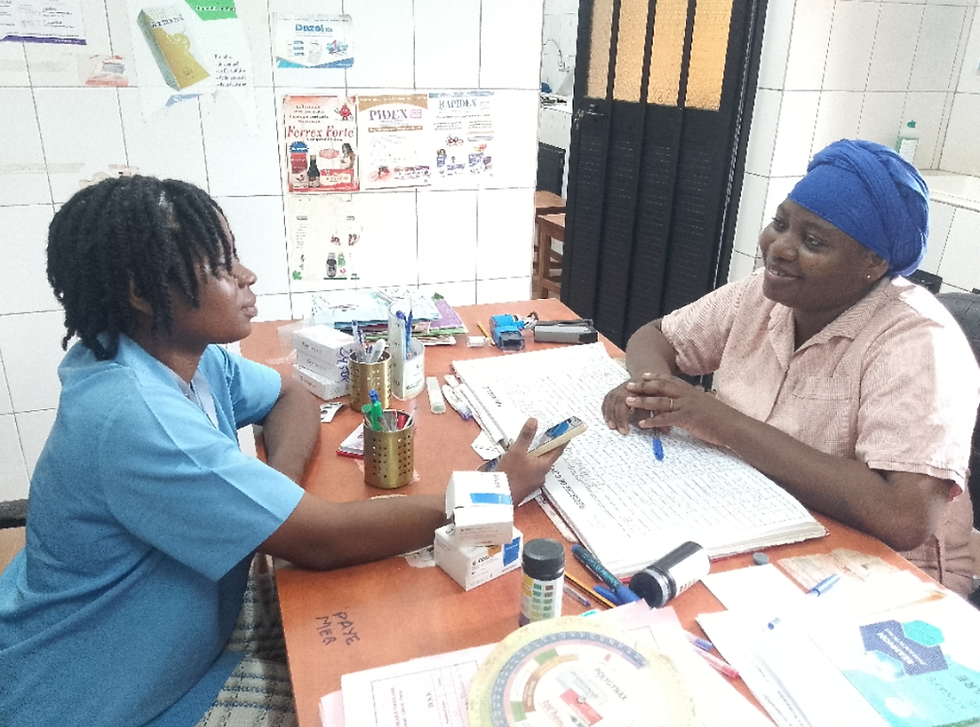
ISCOME enumerator Sophie Kessougbo (left) speaks with
Bemba-Bahaissa Alimatou, who manages contraceptive supply and family planning
advising at Mission Tové hospital in Togo.
One user conversation particularly underscored the need for widespread, informed awareness about family planning. A 40-year-old mother of eight and non-user of contraception, responded to the question, “Who is the most important person to influence your decisions on birth spacing?” She replied, “Hmm… [silence] Your question brings tears to my eyes because if someone had been talking to me about this, I wouldn’t be in this situation today with my eight children.”
After one week of airing on two stations, we spoke with 39 listeners which revealed high ad recall (37–38 listeners per ad). For Ad 1, 29 listeners correctly recalled the core advice, and 23 reported discussing it with someone else. For Ad 2, 24 listeners recalled the advice accurately, with 16 reporting subsequent discussion.
High recall paired with social discussion suggests the content is both understandable and conversation-worthy, supporting its potential to shift norms and behavior at scale.
Strengthening the Evidence Base for our Model
Generating robust evidence about our work is central to FEM’s long-term strategy, even as we deliver impact based on strong preexisting evidence. We are working to conduct an RCT in three regions in Nigeria. In 2025, shifting contraceptive supply conditions required us to reassess our RCT states. Following this re-analysis, we installed 30 units of evaluation technology across the first-wave states of Abia, Katsina, Nasarawa, Ogun, and Ondo.
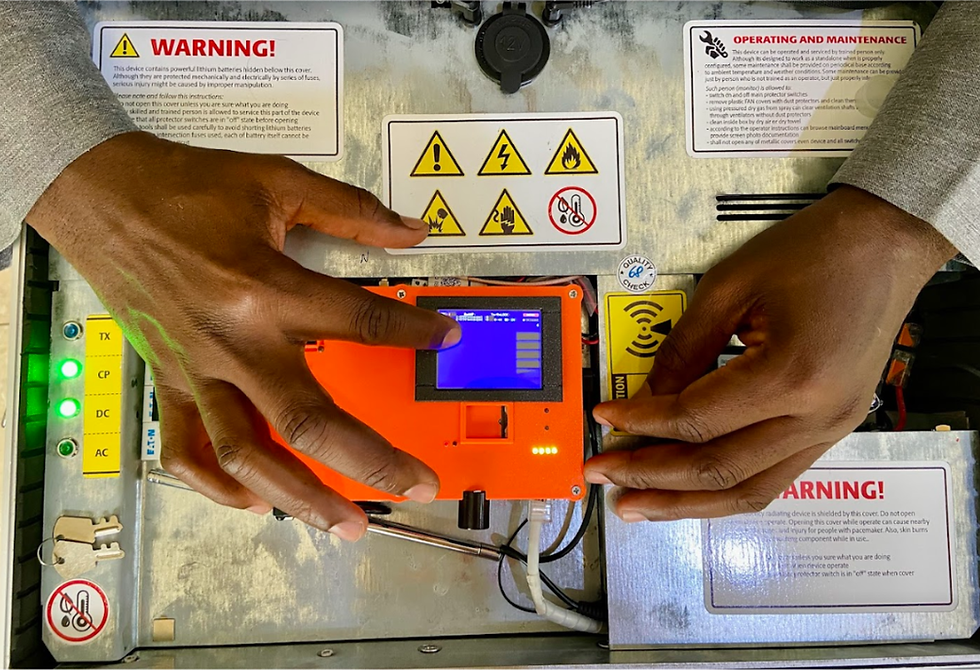
Engineer Jamilu Dahiru demonstrates the small-scale transmitter which identifies
when FEM’s content is on air and replaces it with unrelated material
We’re using technology innovated for this study with our partner, the Czech design firm UNITRONIC. Small-scale radio transmitters identify when FEM’s content is on air and replace it with unrelated content in a small radius, allowing us to create control groups. We can then compare self-reported rates of family planning between communities that hear our campaign and those that do not. As a glimpse at the project’s complexity: in the original 10 states, we assessed 615 possible sites for transmitter installation (from 1,000+ screened), visited 405 in person, and confirmed 119 as viable. Eight were later dropped due to changing security conditions.
While the transmitters perform as expected in manual tests, they are not yet triggering reliably during live radio broadcasts. Many RCT radio stations transmit weak, distorted, under-modulated, or mono audio, making it difficult for transmitters to detect the embedded codes that trigger content replacement during live broadcasts. By year’s end, we completed a first round of troubleshooting and initiated a second. Throughout this work, the team has remained engaged and committed, even as timelines have extended.
Historical Impact: Mixed Evidence from Kano
An independent academic study was published evaluating our Kano campaigns, the first quasi-experimental analysis of our work. Its finding contrasts with existing positive evidence, making the overall picture for the effectiveness of our Kano campaigns mixed.
Existing positive evidence comes from external surveys by PMA Data, which show substantial increases in self-reported contraceptive use over periods overlapping with our campaigns. Among all women in Kano, modern contraceptive prevalence rose from 8% to 14% between February 2021 and January 2022. Among married women, our primary target audience, use more than doubled, from 9.9% in 2021 to 20.2% in 2024. PMA’s most recent survey (December 2023 – February 2024), conducted after our longer campaigns, suggests this increase was sustained. These data are correlational and do not include a control group, so they cannot establish causation, but the timing is consistent with a meaningful positive effect.
By contrast, the academic study used routine health system data (DHIS2) and did not find a sustained increase in family planning service use in Kano relative to Jigawa. We take this finding seriously, but interpret it cautiously. Several features of the study design, noted by the authors in their paper, make it difficult to draw confident conclusions from its results.
One limitation is the exclusion of facilities with incomplete reporting. Of 1,565 health facilities in Kano, the study retained 376 (24%) within its analytic sample, with similar exclusions in Jigawa. Those excluded facilities are more likely to be under-resourced and isolated, and therefore systematically different from those retained. The analytic sample is therefore unrepresentative of the full facility landscape in either state, limiting what conclusions can be drawn about campaign impact across Kano.
Two other limitations bear on the interpretation. First, roughly 52% of outpatient care in Nigeria occurs in the private sector and this is minimally captured in DHIS2. Any demand the campaign generated through those channels would likely be invisible to the study. Second, Jigawa may not be a strong counterfactual for Kano. Demand satisfied among women by modern methods was 29% in Kano and 19% in Jigawa in the 2023/24 DHS, suggesting the two states differ structurally in ways that complicate direct comparison.
We view the PMA data as a more direct measure of contraceptive use than partial facility-based service data, while recognizing that it is correlational and cannot establish causation. We are not relying on either source as definitive. That is why we are investing in a large-scale RCT: to build direct evidence of our model's impact under rigorous conditions.
The Kano evidence increases our uncertainty, but our current model already applies a 30% uncertainty discount to the effect size from the Burkina Faso RCT of a similar intervention. Even applying a total discount of 85% to the assumed effect size, we estimate that our cost-effectiveness in Nigeria would be equivalent to 10x cash.
Leadership Transition and Organisational Update
FEM is entering a new leadership chapter, with Kenneth Scheffler and Lia Boldt continuing leadership as co-directors. Over the past two years, while Anna Christina Thorsheim completed a master’s degree, Lia and Ken co-led the organisation’s day-to-day work through a period of growth, RCT adaptation, and expansion into Niger, Benin, and Togo.
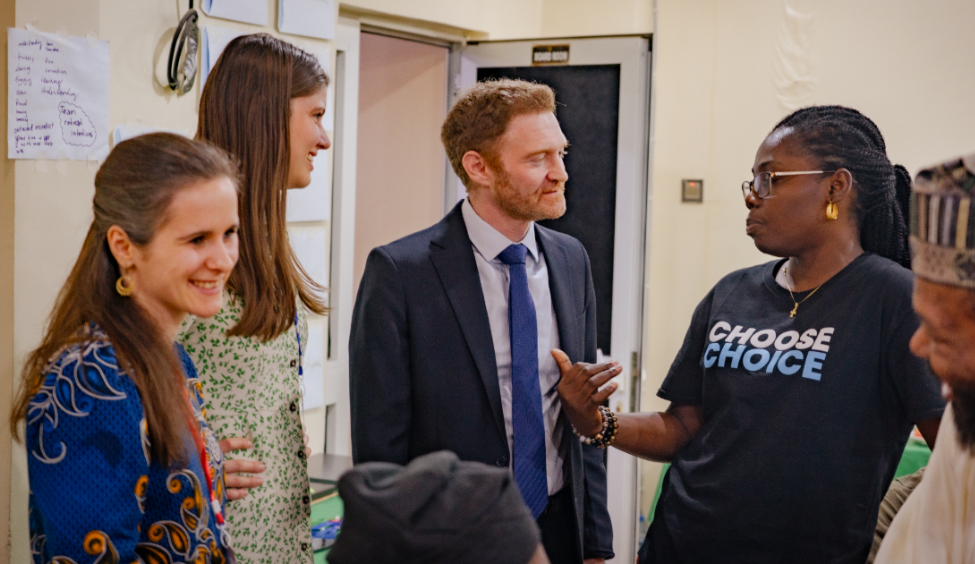
Lia Boldt (left) and Ken Scheffler (center) speak with MSI Nigeria Reproductive Choices
Programme Director Ogechi Onuoha and Anna Christina Thorsheim.
Lia has a background in developing and evaluating global health interventions, with prior work at UNESCO and GIZ and experience across Cambodia, Ethiopia, and South Africa. Ken’s background is in program management and evidence use, with previous experience at Innovations for Poverty Action, USAID, and Dalberg.
Effective June 1, Anna Christina is expected to transition from Executive Director to Board President, where she will continue to help shape FEM’s long-term strategy and guide key organisational decisions. She is co-founding Elevate Philanthropy with Joey Savoie to help address limited funding for highly effective global development initiatives.
With strong leadership in place, FEM is well positioned for its next phase, including hiring additional managers to support rollout in Nigeria and future expansion.
Looking Ahead: Fundraising for the Next Phase
Next, FEM will continue airing in Kaduna, launch a two-year campaign in Niger, fundraise for a campaign in Togo and the RCT, and move forward with the RCT baseline survey and campaign launch as soon as the evaluation technology is operational.
FEM is raising $1.4 million to deliver full campaigns in Nigeria and Togo and conduct an additional proof of concept in 2026. This funding will allow us to both deliver immediate impact, expand into new countries, and strengthen the evidence needed for future scale.
Over the life of these campaigns, we estimate this funding could:
Reach ~17.6 million potential listeners
Prevent ~170,400 unintended pregnancies
Generate rigorous evidence through a large-scale RCT
Support expansion to two more high-impact countries
Support our work
Donate. Your donation helps us improve maternal health by enabling more informed family planning, in Nigeria and beyond. Reach out to hhart@familyempowermentmedia.org for additional donation options.
Give us feedback. We want to hear from you!
Spread the word. Do you have a friend or a colleague who may be interested in our work? Share this post.
Interested in joining our team, or know someone who might be? Please watch for openings!
Keep updated: Sign up for our newsletter at the bottom of the page.


Comments